ARMIG SANTOS: BALADAS
Lévy Gorvy Dayan is delighted to announce the gallery’s first solo exhibition Baladas with Puerto Rican artist Armig Santos.
April 16 — June 13, 2026
The exhibition will debut a series of canvases that explore the artist’s personal and pastoral relationship to the islands of Puerto Rico, drawing upon historical, archival, and ecological sources of inspiration.With the exhibition’s title, Santos nods to José Luis González’s 1978 novel Balada de otro tiempo (Ballad of Another Time), which remains a significant representation of traditional farming—or campesino—culture in Puerto Rico. Remarking on his new body of work, Santos states, “Every painting is a ballad to Puerto Rico in its own way. The works are reminders of the past but also a way to understand what is happening now.” History infuses Santos’s paintings in myriad ways—from colonial references to romantic portrayals of Puerto Rico’s heritage. In creating his works, the artist traverses the geography of his homeland, drawing attention from the coastlines—that famously distinguish the islands—inland to the mountains where he was born and where campesino life flourished. Featuring a vibrant mountain range, the largest canvas in the exhibition Balada del paraíso (Paso Fino) (2023–25) is among Santos’s cycle of Paso Fino paintings (2023–), titled after the horses which were brought to the Caribbean by Spain and became integral to Puerto Rican culture. Here, a lone cowboy appears astride his Paso Fino in the sun-drenched landscape, while fragments of an earlier nocturnal self-portrait emerge in the background. Santos notes, “With the Paso Fino paintings, I was interested in how an image can have a Puerto Rican identity but also be universal.” The series further reveals the artist’s art-historical influences, from the equine paintings of Pablo Picasso’s Rose Period to the Tahitian canvases of Paul Gauguin.
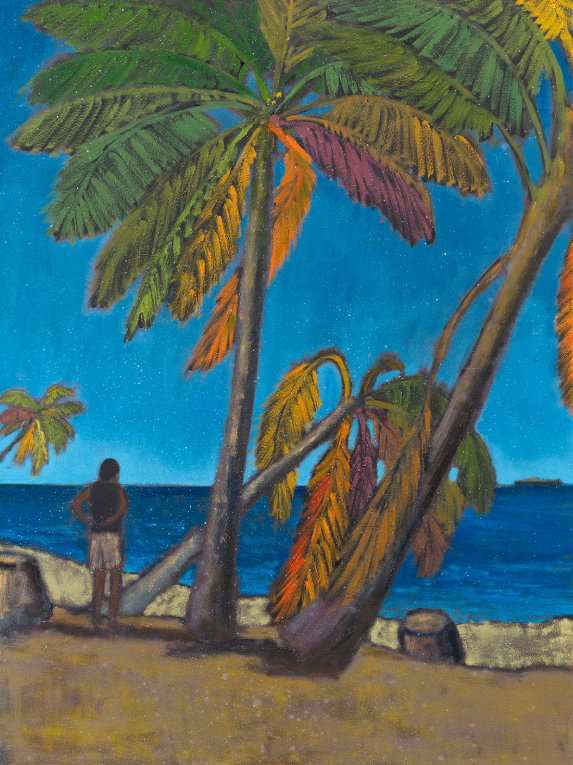
In framing his work, Santos considers sources that have externally established perceptions of Puerto Rico, most notably the imperialist two-volume Our Islands and Their People as Seen With Camera and Pencil (1899), which widely introduced Puerto Rico, the Philippines, and Guam as well as Hawai‘i and the Samoan Islands to American audiences through copious photographic illustrations alongside data and observations by the United States military. He further cites events between Puerto Rico and the United States—from the economic Operation Bootstrap, initiated in the 1940s, to the US military occupation and withdrawal from the islands in 2003 and 2004, and the environmentally catastrophic Hurricane Maria in 2017. This history is encapsulated in paintings such as La isla que se repite (2025), portraying a tank left behind by the US Navy on Flamenco Beach in Culebra. Now intrinsic to the white sands and blue waters of the natural landscape, the rusted tank “represents decay within a beautiful image” in the words of the artist.
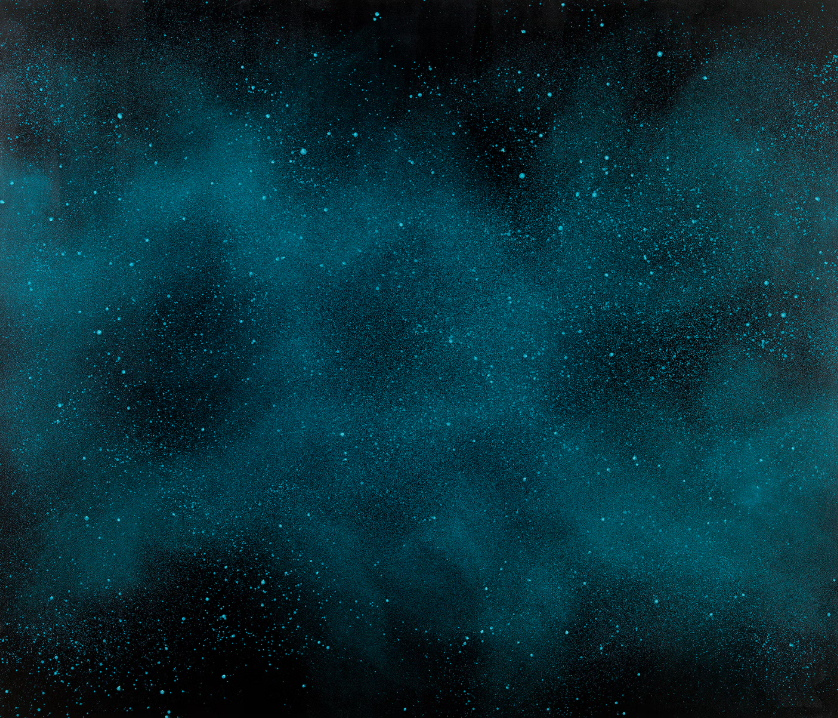
Puerto Rico’s natural ecosystems and their incursion by destructive forces also underlies the artist’s Bioluminescence series (2021–). Santos recounts that nineteenth-century literature describes light-emitting microorganisms throughout the islands of Puerto Rico; now, few locations remain. Created with turpentine and oil paint, Santos’s compositions echo the bioluminescent patterns he witnesses during his annual trips to Mosquito Bay during the new moon. Ecological, spiritual, and based in memory, the paintings appear abstract yet are figurative, grounded in the islands’ ancient natural phenomenon. Of these canvases and of the paintings on view in Baladas Santos reflects, “Instead of looking elsewhere, I wanted to look to Puerto Rico and its history for inspiration.”