SARAH MISKA: BRING FORTH THE HORSE!
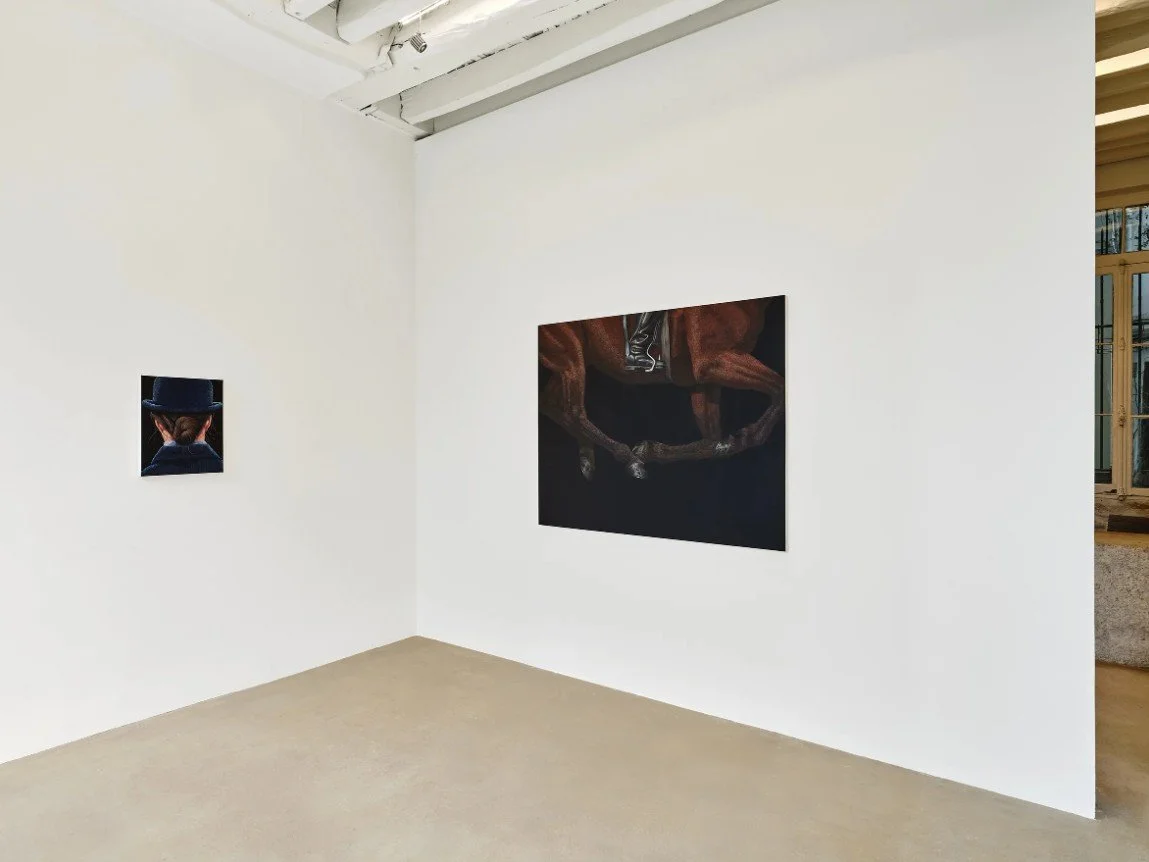
To celebrate the beginning of the Chinese New Year, the Year of the Horse, MASSIMODECARLO Pièce Unique is pleased to present Bring forth the horse!, Sarah Miska’s first exhibition in Paris.
February 17 – 29, 2026
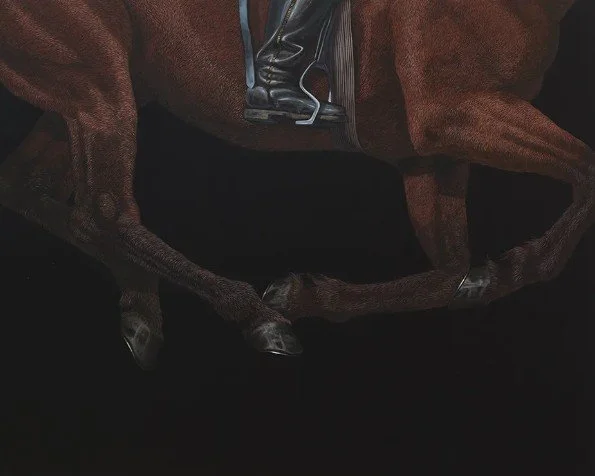
Miska’s figurative practice is characterized by a specific feature: each subject contains multiple facets of the equestrian world. The two works on display depict the body of a horse in full gallop and a figure in competition attire. Their titles reveal the main themes the artist chose to explore and to present to the public – namely, the movement of the gallop (Gallop) and the bowler hat (Bowler Hat), adopted as a staple of equestrian fashion.
Miska’s passion for horses, which she has nurtured since childhood, does not appear to stem from any specific moment or incident. The artist herself states that she grew up in an environment where horses and equestrianism dominated the collective imagination; yet, due to the elitist nature of the practice, she admits that it was not easy – and still isn’t – to feel fully part of that world.
For Miska, painting thus becomes a practice of belonging, in which the concept of control proves central: “Equestrian riding has everything to do with control, both of yourself and movement. It’s truly all about presentation – just this perfect, precise thing”. This control then materializes in her painting, which is realistic and hyper-detailed, in her mastery of both technique and subject. Her close-up compositions are often taken from photos she finds online or scenes she sees when visiting stables, which she reproduces, adding details of her own invention. The rigor of the canvases – from the compositional construction of the subject to the painterly technique – also pays homage to the close-ups of Domenico Gnoli, an evident reference in the precise renderings.
Her interest in detail guides her representational choices: to focus attention on the rhythm of the gallop, Miska depicts only the lower part of the horse’s body, thereby concealing the elements that would identify it. It does not matter which horse it is, nor do we need to see the face of the rider with their foot in the stirrup. What matters is the movement and the control exerted over it. The black background also allows the viewer to concentrate on the gallop: there seems to be no ground, yet the painter still manages to show that it is the moment of suspension that is being depicted. The legs are bent to convey the interval between the upward thrust, the jump, and the descent. The body is placed exactly at the center, frozen in time while remaining in motion.
Miska dedicates both paintings to the Year of the Horse: “Because this is the year of the horse, I wanted a sense of freedom and a horse at full gallop felt like the perfect image”, she explains. According to Chinese tradition, the horse’s energy releases freedom, speed, and the desire for change. Since the year is ruled by the element of fire, the artist emphasizes the impulsive force and tension of movement: the gallop becomes a forward and upward thrust.
The idea of control as an operational principle is also central in Bowler Hat, where Miska presents a figure seen from behind. The hat and the bun, as well as the jacket, are rendered with extreme precision in their textile structure. The hair, perhaps because the competition has just ended, is not still but appears disheveled, as if blown by the air. The rigid structure of the pictorial composition – the subject is clearly outlined, the brushwork defined, decisive, controlled – stands in contrast to the sense of movement the hair seems to suggest. This very contrast evokes the strict rules of dressage – a discipline in which the horse and the rider execute geometric, perfectly synchronized figures, and where aesthetics is governed by actual mechanisms of bodily control. In dressage, not only is every gesture measured, coded, and repeatable – the rider must govern their own body and that of the horse through a series of minimal, almost imperceptible signals so that the action appears natural and effortless – but the body is also shaped according to precise norms, until it becomes an instrument of a preordained choreography.
By depicting the figure from behind, the artist invites us to share her perspective. She does not ask us to look at her head-on, as if facing a figure that stands before us to be observed; rather, she involves us in an act of identification or participation in the moment portrayed.