ZIO ZIEGLER: The Tesseract
Almine Rech is pleased to present 'The Tesseract', Zio Ziegler's fourth solo exhibition with the gallery, in New York.
September 16 - October 21, 2026.
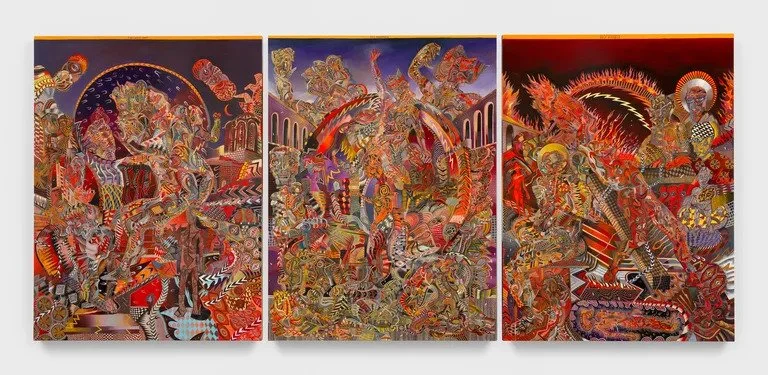
Like Foucault’s pendulum, which moves in an ellipse as it oscillates between its outer limits, Zio Ziegler’s 'The Tesseract' swings the viewer in whirling, elliptical fashion from one aesthetic mode to another. From the thickly patterned world of his monumental and maximalist pictures, to the exploratory mark making of his skeletal monochrome canvases. And from the visceral and layered forms of his so-called “Essential Figures,” to his similarly totemic three-dimensional figures whose dynamism he has stilled in bronze.
Language, myth, and symbol are at the heart of 'The Tesseract'. Ziegler conceived of the series after reading several of humanity’s oldest narratives: Ovid’s Metamorphoses, the Epic of Gilgamesh, and the Bible. Like his textual influences, which Ziegler sometimes quite literally registers in his pictures (he calls his maximalist paintings “illuminated manuscripts”), his library of art historical influences is also voluminous. Throughout we find the cowering figures of Adam and Eve from Masaccio’s Expulsion from the Garden of Eden, the slumped contrapposto of Christ in Rubens’s Descent from the Cross, and the ring-like rainbows of Memling’s Last Judgment.
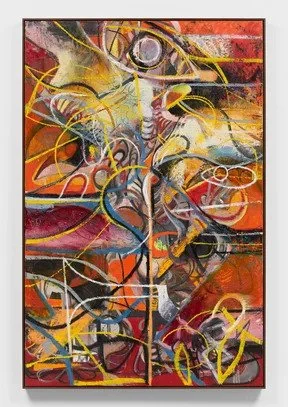
By considering historical religious image-cultures alongside modern traditions of image-making, Ziegler is undaunted by the suspicion toward the religious that prevails in contemporary art. In his use of religious subject matter, Ziegler circumvents questions of belief or unbelief, and points instead to the possibilities of images to kindle the senses, awaken subjectivity, and spur feeling. It’s perhaps not coincidental, then, that he should call these pictures “relics” for the way they provoke the nervous system, not simply the intellect. Whether the dense patterns of his maximalist representational works or the impulsive marks across his more abstract pictures, we find bodies and surfaces teeming with energy.
In the end, Ziegler refrains from overt ethical judgment or prediction, but he acknowledges that the transformation that lies on the other side of this modern-day expulsion myth will not arrive without turmoil. In one painting, a single face (whose likeness recalls Ziegler himself) stares out at the viewer against a golden background, with hair tousled like a crown of thorns. It recalls the devotional type known as the “Man of Sorrows,” where Christ, both dead and alive, wears a crown of thorns and displays the wounds of his crucifixion. In other paintings, we see Ziegler in the thick of the pictorial melee, at his easel or seated in contemplation.